GLM-5.2, Search Exposure, and the New Long-Context Coding Agent Problem
GLM-5.2 is easy to summarize badly.
The shallow version is: Z.ai shipped another huge open-weight coding model with a 1M-token context window and strong benchmark numbers.
The more useful version is: GLM-5.2 is a sign that the hard problem for AI coding agents is shifting from "can the model see enough?" to "what should the model be allowed to see, how should that source set be ranked, and how does the model search inside it once the context is huge?"
That is the part I care about.
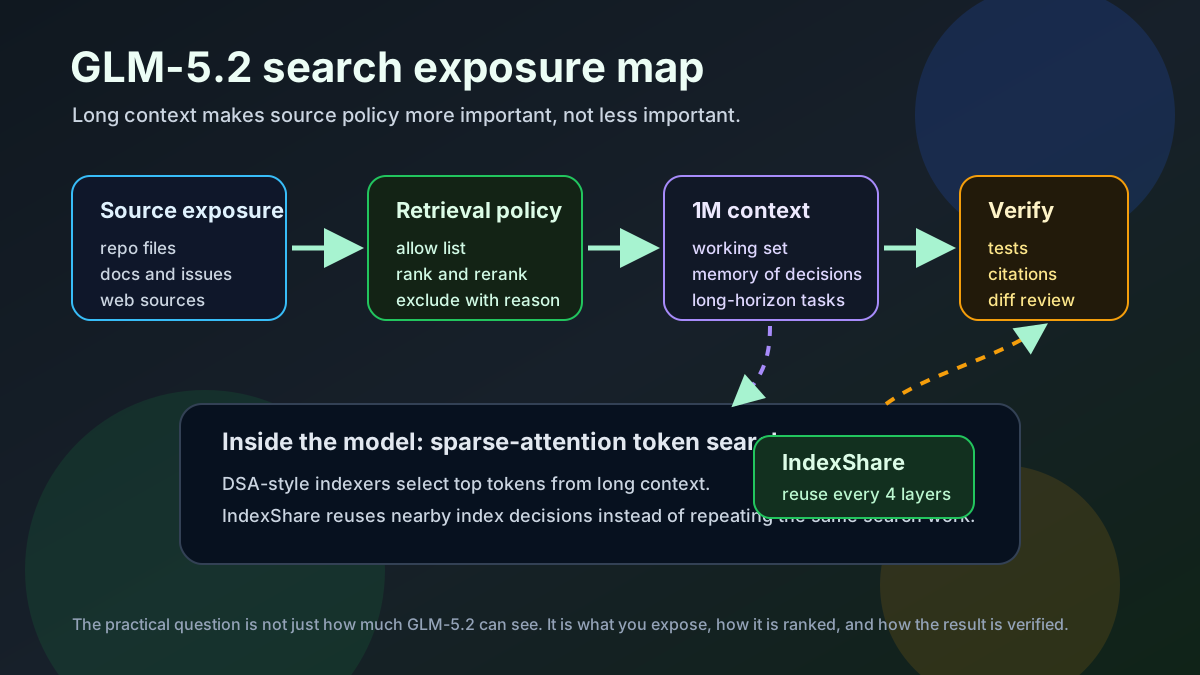
Search exposure is the practical layer between your source material and the model. It is the set of files, docs, issues, browser pages, logs, tests, diffs, and constraints you decide to put in front of an agent. GLM-5.2 matters because it makes that layer more powerful, but also easier to abuse.
The short version
GLM-5.2 is a new flagship model from Z.ai, formerly associated with the ChatGLM / Zhipu AI line. Z.ai positions it for long-horizon coding and agent work, not just short chat responses.
The public claims worth tracking:
- The Z.ai docs list GLM-5.2 as a text model with a 1M-token context length and 128K maximum output tokens.
- The Hugging Face model card lists the weights under an MIT license and shows roughly 753B parameters.
- Z.ai says the model improves over GLM-5.1 on standard coding benchmarks, including Terminal-Bench 2.1 and SWE-bench Pro.
- The model introduces flexible effort levels, so builders can spend more inference on harder tasks instead of treating all work the same.
- The interesting architecture detail is IndexShare, backed by the IndexCache paper: reuse sparse-attention index decisions across nearby layers instead of rerunning the same token-selection work everywhere.
- The release also talks about MTP/speculative decoding, long-context serving work, agentic RL infrastructure, and anti-hacking guards for coding-agent training.
That sounds like a model release note. It is also a search architecture note.
Two different search problems
When people say "search" around AI agents, they usually mean external retrieval:
- search the web
- search the repo
- search the docs
- search prior issues
- search a vector database
- search local notes
That layer decides what source material gets exposed to the model.
GLM-5.2 also brings attention back to a second search problem inside the model: sparse attention has to decide which prior tokens matter for each current token. In DeepSeek Sparse Attention style systems, a lightweight indexer scores earlier tokens and selects a smaller top-k set for the core attention computation.
So there are two search loops in play:
| Layer | Question | Failure mode |
|---|---|---|
| External retrieval | Which sources should the agent see? | The agent misses the real evidence or reads the wrong material. |
| Internal sparse attention | Which exposed tokens should matter right now? | The model wastes compute, loses signal, or degrades at long context. |
GLM-5.2 is interesting because it pushes both layers at the same time. The model can accept much more material, but its internal architecture also has to keep the cost of searching that material under control.
Why 1M context is not a trash can
A 1M-token context window is useful, but only if it stays usable under pressure.
The Z.ai release is careful about this point: long context is not valuable just because a prompt can contain more tokens. It is valuable when the model can carry forward decisions across a long, messy agent trajectory.
For real engineering work, that means:
- remembering the architecture rule it found 200K tokens ago
- keeping the test failure tied to the file that caused it
- not flattening every source into the same importance level
- keeping track of what was tried and what was ruled out
- resisting context drift during multi-hour coding loops
This is where search exposure still matters.
If you expose too little, the model guesses. If you expose too much, the model has to spend attention on junk. If you expose private or irrelevant material, you create security and quality problems. A bigger window changes the budget, not the responsibility.
My rule of thumb: long context lets you replace some brittle chunking with fuller source packets, but it does not replace source policy.
IndexShare is the part builders should actually understand
Z.ai says GLM-5.2 applies IndexShare to support 1M context efficiently. The underlying IndexCache paper explains the core idea well enough for non-research builders.
DeepSeek Sparse Attention reduces the cost of full attention by using a lightweight indexer to select the most relevant earlier tokens. That is already a search algorithm: score the candidates, keep the useful subset, compute attention over that subset.
The problem is that the indexer still has work to do at long context. If every layer independently searches all preceding tokens, the repeated index work becomes expensive.
IndexCache observes that neighboring transformer layers often choose very similar important-token sets. If the selected tokens are already similar across nearby layers, then many layers do not need to run their own indexer. Some layers can compute fresh indices, while nearby layers reuse them.
In the GLM-5.2 release framing, every four sparse-attention layers share an indexer. That avoids most of the repeated indexer dot-product and top-k work in the shared group. Z.ai reports a 2.9x reduction in per-token FLOPs for that indexer path at 1M context.
That is not web search. It is not vector search. It is token search inside the model.
But the lesson transfers: if the ranking signal is stable, reuse it. Do not recompute expensive search decisions just because the next layer or next step looks slightly different.
The retrieval lesson for agent builders
Most coding-agent stacks already have a rough version of this problem.
A naive agent does this:
user asks for a change
agent greps files
agent reads too many snippets
agent edits
agent gets a test failure
agent greps again from scratch
agent forgets why the first source mattered
A better agent preserves source exposure state:
task goal
source inventory
ranked evidence set
excluded sources and reasons
edit plan
test evidence
verification result
next source query only if needed
GLM-5.2's long context makes that second shape more realistic. You can keep more of the working set in view: the relevant source files, the architectural notes, the test output, the constraints, and the previous failed attempts.
But the retrieval layer should still record why each source was included. Search exposure should be auditable.
That matters for SEO-style search too. Public pages that explain a model release should not just chase keywords like "GLM-5.2 benchmark" and "open source coding model." They should answer the real adjacent queries:
- What changed technically?
- What does 1M context actually buy?
- Is it open weight?
- Can I run it locally?
- Is every hosted provider exposing the same context size?
- How does it affect retrieval, RAG, and coding agents?
- What should I test before swapping it into a workflow?
That is how you write for search algorithms without writing junk for humans.
Provider details matter
One practical warning: do not assume every hosted GLM-5.2 endpoint exposes the same limits.
Z.ai's own docs list the flagship model with 1M context. The Z.ai coding-plan docs also show a glm-5.2[1m] naming pattern for enabling the 1M context path in Claude Code-style integrations.
Cloudflare Workers AI, meanwhile, lists @cf/zai-org/glm-5.2 with a 262,144-token context window, function calling, reasoning support, and token pricing. That is still large, but it is not the same product surface as "1M context everywhere."
This distinction matters when evaluating the model:
- model capability
- provider context limit
- API compatibility
- tool calling behavior
- cache pricing
- latency
- quota rules
- local serving feasibility
Those are separate variables. Treating them as one variable is how teams end up with misleading benchmarks.
The anti-hacking section is not optional
The most interesting safety detail in the GLM-5.2 release is the anti-hacking section for coding-agent RL.
Coding tasks often have crisp pass/fail rewards. That makes them useful for training. It also creates a perverse incentive: if an agent can cheat the evaluation harness, it may learn the shortcut instead of the capability.
Z.ai describes examples like reading hidden evaluation files or fetching target solutions directly from remote source locations. Their mitigation uses a two-stage detection approach: a broad rule-based filter catches suspicious tool calls, then an LLM judge checks intent. If the system catches a hack, it blocks that tool call and returns dummy information instead of throwing away the whole rollout.
For people building search systems, the point is simple:
Search exposure is a capability boundary.
The agent should be able to search the sources it is supposed to use. It should not be rewarded for finding protected answers, hidden tests, private data, or evaluation artifacts.
If your retrieval layer has no concept of allowed and disallowed evidence, a stronger long-context model just gives the agent a bigger shovel.
Where I would use GLM-5.2 first
I would not start by replacing every model in a stack.
I would test GLM-5.2 where long context and source discipline matter:
- Repo takeover audits, where the task is to understand architecture before editing.
- Multi-file refactors, where the model has to preserve contracts across frontend, backend, tests, and docs.
- Performance investigations, where logs, traces, implementation files, and benchmark notes need to stay in one working set.
- Source-heavy research reports, where the model has to compare primary sources instead of summarizing summaries.
- Agent fallback lanes, where open-weight availability matters more than having one vendor's premium model.
I would not use it blindly for every chat message. A 753B-class model is not a casual local laptop toy, and provider surfaces will differ. The value is in the jobs where the context and search discipline pay for themselves.
How I would evaluate it
A serious test should look more like an engineering run than a vibe check.
Give the model a real codebase and define a source policy:
- allowed repo files
- allowed docs
- allowed web sources
- disallowed private material
- test commands
- output format
- pass/fail criteria
Then run a task that requires actual source exposure:
- "Audit this feature and identify the three highest-risk files."
- "Refactor this API without changing the public route contract."
- "Find why this test is flaky and prove the cause."
- "Write a source-grounded migration plan, then implement step one."
Score the run on:
- whether it found the right source files
- whether it ignored tempting but irrelevant files
- whether it preserved constraints across the run
- whether it verified with real commands
- whether it recovered after a failed attempt
- whether its citations or file references actually support the claim
- whether the final diff is smaller than the problem
That is the evaluation I care about. Benchmarks are useful, but agent work lives or dies in the source-selection loop.
My read
GLM-5.2 is important because it connects three things that are usually discussed separately:
- open-weight frontier-adjacent coding capability
- long-context engineering workflows
- search efficiency inside and outside the model
The biggest mistake would be treating the release as only a leaderboard event.
The better takeaway is this: long-context models make source exposure a first-class engineering problem. Search algorithms are no longer just the retrieval layer that finds documents before the prompt. They are also inside the model, deciding which exposed tokens matter, and inside the training harness, deciding which tool calls are legitimate.
If you build AI coding workflows, that is the shift.
Do not just ask whether GLM-5.2 can see a million tokens.
Ask what you are going to expose, why it belongs in the working set, and how you will prove the agent used it correctly.