#OpenJarvis Is the Local AI Agent Project to Watch Right Now
Published: June 4, 2026
Topic: #OpenJarvis, local AI agents, on-device personal AI, agent frameworks
OpenJarvis is not interesting because the name sounds like every Iron Man-inspired assistant demo from the last decade.
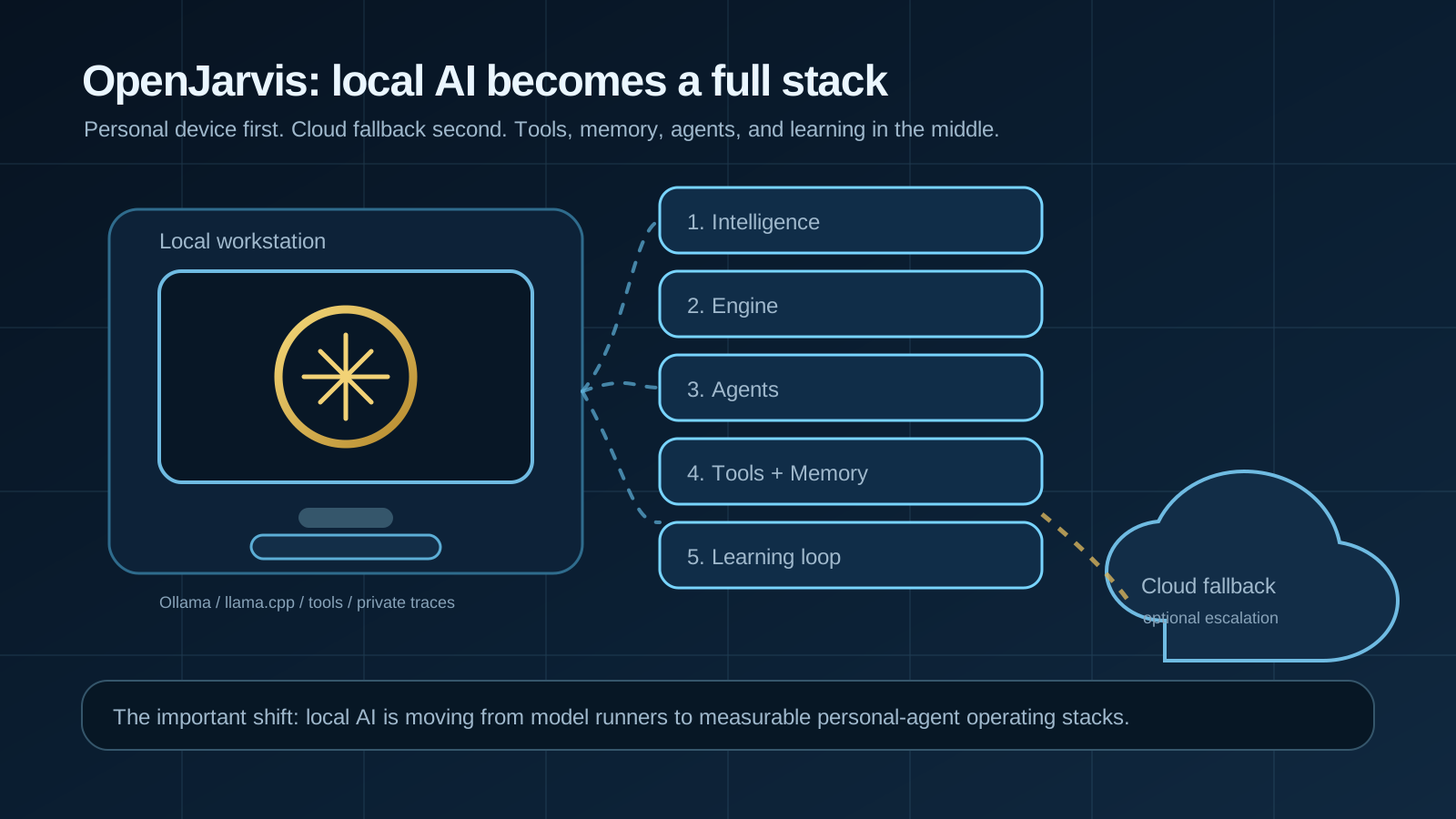
It is interesting because it points at the next serious fight in AI tooling: whether a personal AI assistant should be a cloud product with a nice desktop shell, or a local-first software stack that can run on your own hardware, use your own tools, learn from your own traces, and call the cloud only when the local path is not good enough.
That distinction matters.
The repo describes OpenJarvis as “Personal AI, On Personal Devices.” The paper behind it goes further: existing personal AI agents route a lot of private, local work through cloud frontier models, and simply swapping those frontier models for smaller local models breaks accuracy badly. OpenJarvis tries to solve that by decomposing the assistant into editable primitives instead of treating the model prompt as the only thing you can tune.
The short version
OpenJarvis is a new open-source personal AI framework from the Stanford / Hazy Research / Scaling Intelligence orbit. It is designed around local-first agents, Ollama-backed inference, tools, memory, skills, scheduling, deep research, code assistance, and optional cloud escalation.
The significant part is not that it can run a chatbot locally. Ollama, LM Studio, llama.cpp, Open WebUI, and half the developer internet already do that.
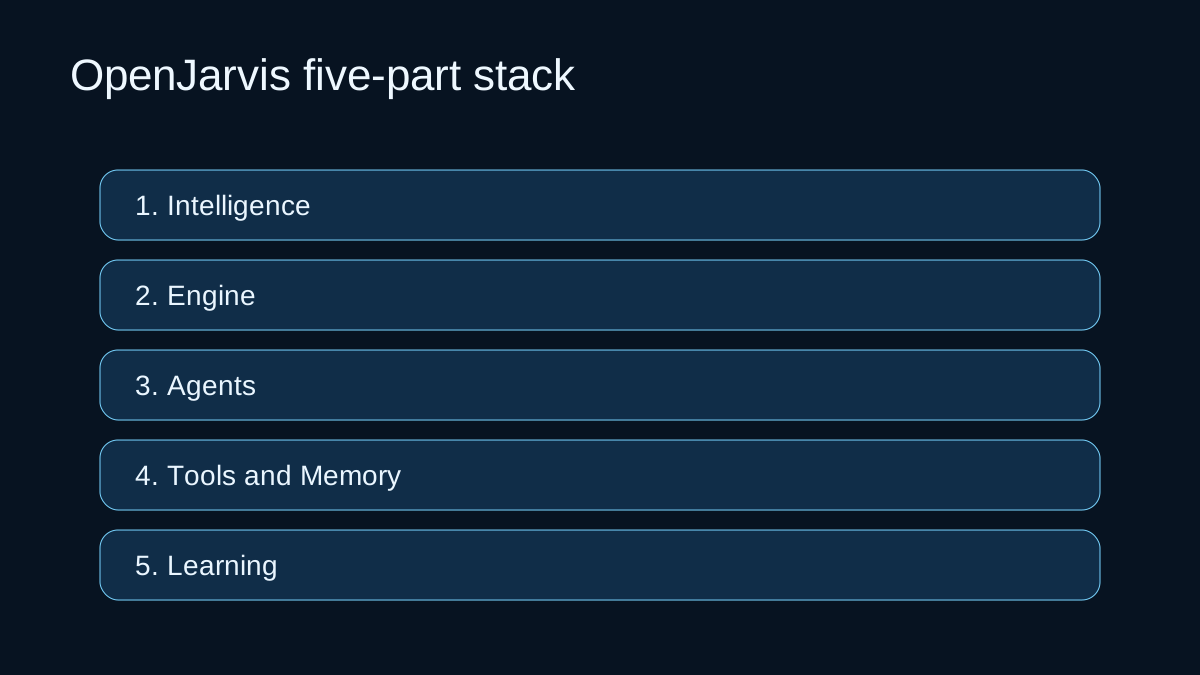
The significant part is that OpenJarvis frames personal AI as a measurable system spec with five editable parts:
That is a much better mental model than “pick a model, paste a system prompt, hope the tool loop behaves.”
Why developers are paying attention today
There are three reasons this project is worth a closer look right now.
First, the timing is good. Developers are tired of paying cloud-model rent for every small agent loop. A local model that answers a single prompt is fine. A local model that can participate in a memory-aware, tool-using, scheduled personal assistant is a different category.
Second, the project is research-backed. The OpenJarvis paper argues that existing personal AI stacks are too tightly coupled to cloud frontier models. When the authors swapped Claude Opus-style cloud intelligence for smaller local models, they found large accuracy drops across personal AI tasks. Their answer is not “make the prompt longer.” It is to expose the full assistant stack as a typed spec.
Third, the headline benchmark numbers are strong enough to draw real attention: the paper reports local/on-device specs that match or exceed cloud accuracy on 4 of 8 benchmarks, land within 3.2 percentage points of the best cloud baseline on average, and reduce marginal API cost by roughly 800x and end-to-end latency by 4x in the reported setup.
That does not mean your old gaming PC suddenly beats Claude, GPT, or Gemini on every task. It means the architecture is attacking the right problem: personal AI needs optimization below the prompt layer.
What OpenJarvis actually includes
The repo is not just a README attached to a dream.
As of publication, the project includes a Python-heavy core with Rust and TypeScript pieces, desktop release artifacts, built-in agents, skills, docs, examples, tests, and a roadmap. The GitHub page lists thousands of stars, over a thousand forks, dozens of contributors, and an Apache 2.0 license.
The built-in agent list is also more concrete than a generic chat demo:
simplefor lightweight chatorchestratorfor tool-selecting multi-turn workdeep_researchfor multi-hop research with citationsnative_reactfor ReAct-style loopsnative_openhandsfor code execution-style workmonitor_operativefor long-running monitoring with memory and retrievalmorning_digestfor scheduled email/calendar/news-style briefingsoperativefor persistent autonomous operation
The skills story is also notable. OpenJarvis says skills are tools that agents can discover from a catalog and invoke when needed. It also advertises imports from Hermes Agent, OpenClaw, GitHub repositories, and the Agent Skills open standard.
That is the bridge senior engineers will notice: this is not only "a local assistant." It is a potential substrate for portable agent capabilities.
The architecture idea: five primitives, not one magic prompt
OpenJarvis decomposes a personal AI system into five editable primitives:
| Primitive | Practical meaning |
|---|---|
| Intelligence | The model or intelligence source available to the system. |
| Engine | The runtime and orchestration machinery. |
| Agents | The behaviours, loops, roles, and execution modes. |
| Tools & Memory | The user-facing capability layer: files, search, calendar, email, retrieval, state. |
| Learning | The loop that measures traces, tunes specs, and improves the system over time. |
That design matters because local AI usually fails when builders pretend the model is the whole product. It is not.
A personal assistant lives or dies on boring things: tool schemas, retrieval quality, memory boundaries, scheduler reliability, redaction, latency, error recovery, and whether the system knows when to stop trying locally and ask a stronger cloud model.
OpenJarvis’s best idea is the typed-spec framing. It makes the assistant configurable and benchmarkable. It turns local AI from a vibe into an engineering surface.
Can it run on a normal developer PC?
Yes, with the usual local-model caveats.
The OpenJarvis install docs provide one-liners for macOS, Linux, WSL2 on Windows, native Windows, and desktop GUI packages. The installer path handles uv, a Python virtual environment, Ollama, and a starter local model. The docs recommend WSL2 as the smoother Windows route, while native Windows is documented as an advanced path.
On a modern developer desktop, OpenJarvis should be feasible. A consumer GPU helps, but the exact model you can run well depends on VRAM, RAM, context length, quantization, and how many tool-heavy loops you expect to execute.
The important distinction: running OpenJarvis is not the same thing as running frontier-class local intelligence.
You can run the framework. You can run small local models. You can wire tools and memory. You can experiment with scheduled agents and local-first workflows. But if you expect an RTX-era gaming GPU to behave like a hosted frontier model, you will be disappointed. The win is not “my machine beats the cloud.” The win is “my machine handles the local default path, and the cloud becomes an escalation layer instead of the entire product.”
Is there a free API key?
For local-first use, no paid API key is required. OpenJarvis can run against local Ollama models.
For cloud fallback, the answer is “sort of,” depending on provider:
| Route | Free? | Useful caveat |
|---|---|---|
| Local Ollama | Yes | Free after hardware/electricity; model quality depends on what your machine can run. |
| OpenRouter | Limited | OpenRouter lists free models and a free-plan request limit. Useful for experiments, not serious production volume. |
| Gemini API | Limited | Google lists free-tier pricing for some models/tools, but free-tier data-use policies and rate limits matter. |
| OpenAI / Anthropic | Usually paid API usage | Chat product subscriptions are not the same thing as API credit. |
The practical setup is simple: use local models for default execution, then configure cloud keys only when a workflow genuinely needs them.
How this compares to other agent frameworks
OpenJarvis is not competing directly with one thing. It overlaps several categories:
- Ollama / llama.cpp / LM Studio: model runners. Great for local inference, but not full personal-agent operating systems by themselves.
- Open WebUI: a strong local/chat UI layer, but not primarily a typed, research-benchmarked agent spec framework.
- LangChain / LlamaIndex: developer frameworks for building retrieval and agent applications, but not specifically positioned as a local-first personal AI stack.
- OpenHands / coding agents: strong for code workflows, but not the same as a whole personal assistant with scheduled memory, channels, and learning loops.
- Hermes-style skills systems: adjacent and potentially complementary, especially if skills can move across ecosystems.
OpenJarvis’s pitch is broader: local-first personal AI as a full-stack architecture.
That breadth is also the risk. Broad frameworks can become complicated quickly. A local-first assistant with channels, tools, memory, learning, cloud fallback, desktop services, and skills can easily drift into “AI operating system” territory before the core workflows are polished.
What is real, and what is hype?
The real part:
OpenJarvis is attacking a serious engineering problem. Local models are getting good enough for many narrow tasks, but personal agents need more than raw model quality. They need measurement, routing, tool discipline, memory boundaries, and a way to improve the whole stack without sending every private action to a hosted model.
The hype part:
“Personal AI on personal devices” still sounds easier than it is. Local agents are fragile. Desktop automation is messy. Permissions are dangerous. Memory can become either useless or creepy. Tool-calling loops can burn time on bad plans. Small models can hallucinate with confidence. And any system that touches email, files, calendars, or shell commands needs a sober security model.
So the right reaction is not blind adoption. The right reaction is: watch this closely, steal the architecture ideas, and benchmark your own workflows before making it central.
The best use case today
The best use case is not replacing your main AI assistant overnight.
The best use case is building a local-first agent lane for work that is:
- repetitive,
- private,
- tool-heavy,
- measurable,
- tolerant of smaller-model imperfections,
- and cheap enough locally that you can run it often.
Examples:
- daily digest generation,
- local document research,
- repo summarization,
- scheduled monitoring,
- inbox triage drafts,
- local skill search,
- personal knowledge-base routing,
- benchmark runs against your own tasks.
That is where local AI gets interesting. Not replacing every cloud model. Reducing the amount of work that ever needs to leave your machine.
Why this matters for AI builders
The OpenJarvis story is really about ownership of the personal AI runtime.
If the assistant lives entirely inside a vendor cloud, you rent the intelligence, the memory model, the tool contract, the agent loop, the data policy, and the failure modes. If the assistant lives locally first, you can own more of the stack: which tools exist, what memory means, what gets logged, what gets optimized, when the cloud is allowed, and what “good enough” means for your work.
That is the line developers should care about.
The next wave of personal AI will not be won only by the best chat interface. It will be won by the systems that make AI feel like reliable personal infrastructure: measurable, inspectable, local by default, cloud-capable when needed, and boring enough to trust.
OpenJarvis is not guaranteed to be that final system. But it is one of the clearest signs that the market is moving in that direction.
Final take
OpenJarvis is worth watching because it treats local AI as a system design problem instead of a novelty demo.
The strongest claim is not that it makes every local model as smart as the best cloud model. The strongest claim is that the personal assistant stack itself can be decomposed, optimized, benchmarked, and eventually run locally by default.
That is the part that sticks.
For developers, the lesson is immediate: stop thinking of local AI as just model serving. Start thinking in terms of typed capabilities, memory policy, evaluation traces, local/cloud routing, skill portability, and measurable workflows.
That is where the useful version of “Jarvis” finally starts to look less like a meme and more like software architecture.