The headline changed because the product changed.
OpenAI has now released GPT-5.6 for general availability. China is warning developers away from a run of Claude Code versions. Anthropic had already accused a China-linked actor of using Claude Code for an AI-orchestrated cyber-espionage campaign.
The useful read is not "who is telling the truth?" as a binary. The useful read is that coding agents have crossed a threshold. They are no longer just text boxes with autocomplete. They are privileged runtimes with file access, shell access, network access, package-manager access, and sometimes enough persistence to keep trying after a human has stopped paying attention.
That is a security boundary. Treat it like one.
What China Is Saying About Claude Code
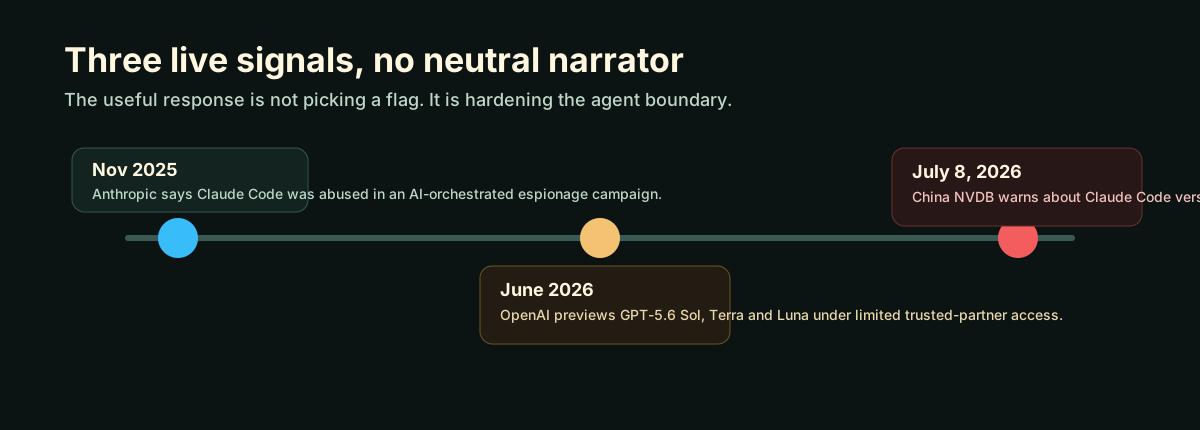
On July 8, 2026, China's Ministry of Industry and Information Technology cybersecurity threat and vulnerability sharing platform, commonly reported as NVDB, warned that Claude Code carried a serious security backdoor risk.
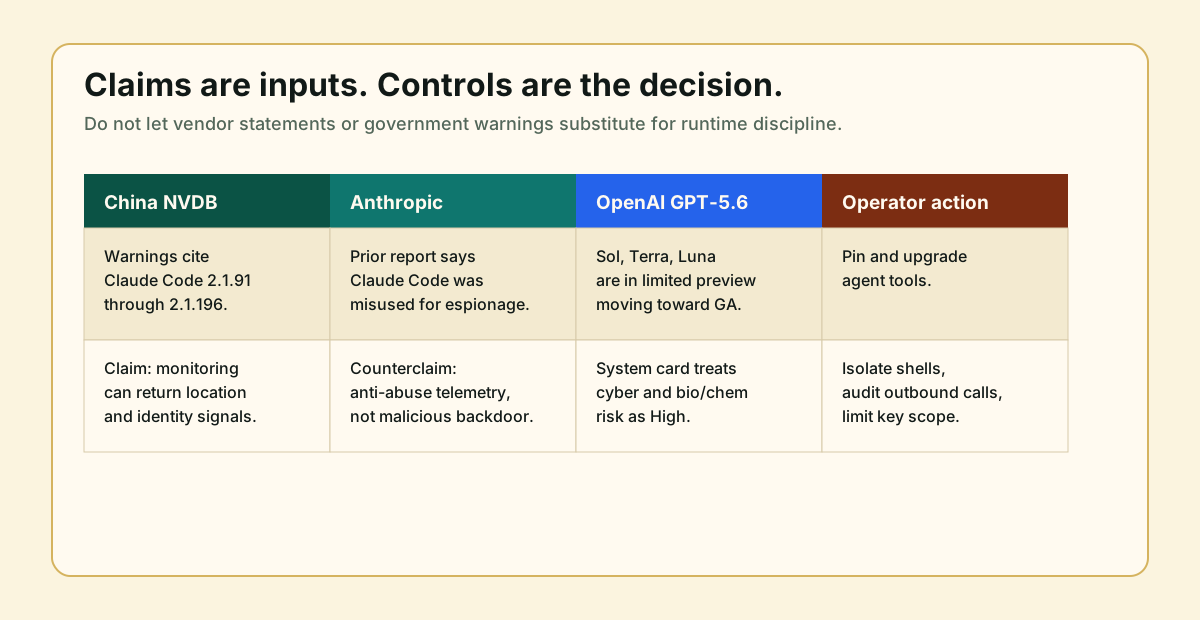
The Chinese reports are specific about the affected range: Claude Code 2.1.91 through 2.1.196. The stated concern is that a built-in monitoring mechanism could send user region and identity-related signals back to remote servers without user consent.
The recommended action is not subtle: inspect developer machines, uninstall or upgrade affected versions, tighten outbound permissions for development tools, and monitor traffic in core business network segments.
That does not prove every loaded word in the advisory. "Backdoor" is a strong term. It implies more than telemetry. It implies covert access, intent, and trust violation. The public reporting I found supports the existence of a monitoring controversy and a concrete version range. It does not give a clean, independently reproduced exploit chain.
So the safe article sentence is:
China warned that Claude Code versions
2.1.91through2.1.196carried a serious backdoor risk tied to built-in monitoring.
Not:
Claude Code is proven spyware.
That distinction matters.
What Anthropic Had Already Said About China
The about-face is that Anthropic had already put Claude Code at the center of a China-linked security story from the other direction.
In November 2025, Anthropic said it had disrupted what it called the first reported AI-orchestrated cyber-espionage campaign. Its post attributed the activity, with high confidence, to a Chinese state-sponsored group. The company said Claude Code had been jailbroken and used across reconnaissance, vulnerability discovery, exploitation, credential collection, and data extraction steps against roughly thirty targets, with a small number of successful intrusions.
That is Anthropic's assessment. It is not neutral ground truth. But it is still relevant because it explains why agent telemetry, reseller detection, model-distillation defenses, and jurisdiction controls are no longer side issues for coding agents. They are now core product behavior.
If a tool can act inside a repository, call external services, and keep enough context to plan an operation, then the difference between defensive automation, vendor abuse detection, corporate telemetry, and hostile tooling becomes much harder to see from the outside.
That is exactly why the operator cannot outsource judgment to either side.
GPT-5.6 Is Now The Other Half Of The Same Story
OpenAI's GPT-5.6 release lands in the same news cycle as this Claude Code fight because both stories are about agentic capability escaping the old mental model.
OpenAI describes GPT-5.6 as a three-model family:
- Sol: the flagship model.
- Terra: the balanced everyday model.
- Luna: the fast, lower-cost model.
The preview is now over. OpenAI says GPT-5.6 is available across ChatGPT, Codex, and the API, with the rollout starting globally and continuing gradually toward full availability over the next 24 hours. ChatGPT, Codex, and API access still vary by plan, workspace, and approved organization, so "released" does not mean every account gets every tier or every effort mode immediately.
The interesting part is not only the model family. It is the operating mode.
GPT-5.6 introduces max reasoning effort and an ultra mode that coordinates multiple agents. OpenAI also describes programmatic tool calling in the Responses API. That is useful. It is also the part a security-minded operator should underline. Subagents multiply the number of tool calls, intermediate decisions, cache boundaries, retries, and places where a system can behave in a way the lead operator did not explicitly intend.
The release also makes the model family easier to reason about operationally:
- Sol is the flagship tier at $5 input and $30 output per million tokens.
- Terra is the balanced tier at $2.50 input and $15 output.
- Luna is the fast, lower-cost tier at $1 input and $6 output.
OpenAI says the family also adds explicit prompt-cache breakpoints and a 30-minute minimum cache life. Those details matter when an agent loop is long enough for cache behavior to become part of the bill.
That is not an argument against GPT-5.6. It is an argument for better controls around any serious agent stack.
High Risk Is Not The Same As Unsafe
OpenAI's GPT-5.6 preview system card treats Sol, Terra, and Luna as High capability in both cybersecurity and biological/chemical risk under its Preparedness Framework. The system card says they do not reach the High threshold for AI self-improvement, and the public safety hub frames the mitigations as tailored to the capability profile.
The practical cyber line is this: the models can find vulnerabilities and assemble pieces of an exploit path, but OpenAI does not present them as successfully performing autonomous end-to-end attacks against hardened targets.
That is the right level of caution for operators.
Do not say GPT-5.6 is "safe." Do not say GPT-5.6 is "dangerous" as a standalone fact. Say the models are capable enough that OpenAI is using a staged preview, extra safeguards, and a High cyber-risk classification.
That is already enough to change how you wire them into development.
The Operator Playbook
The boring controls are the article.
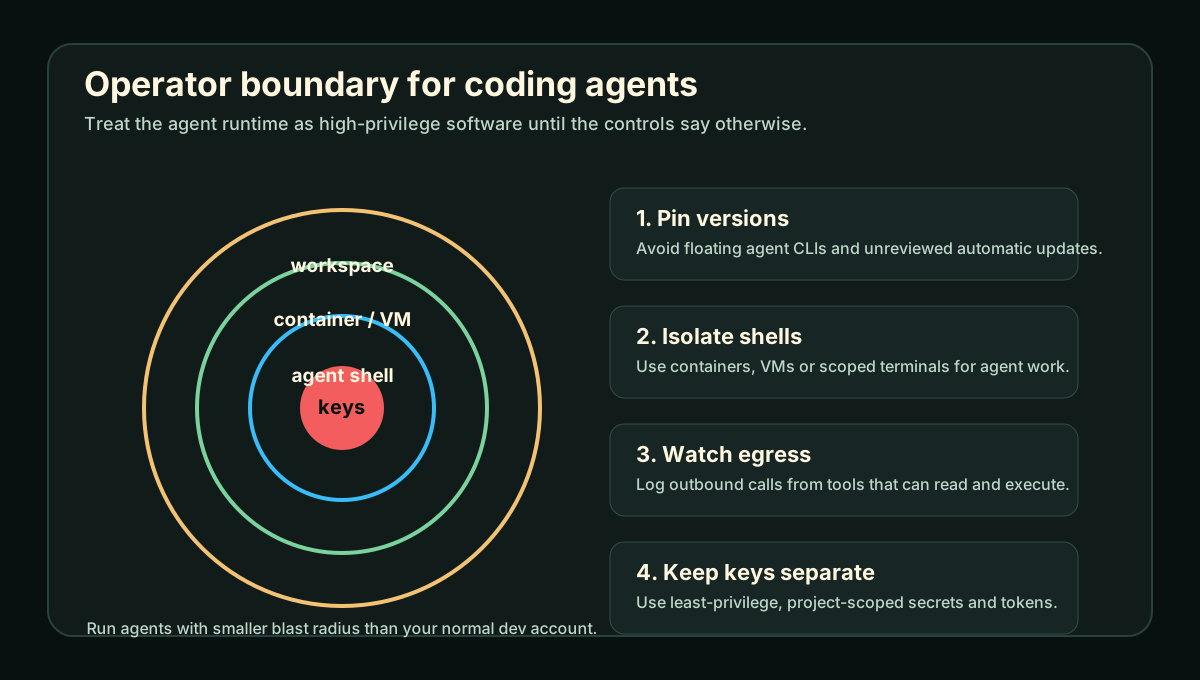
If you run coding agents, start here.
1. Upgrade Or Remove Flagged Claude Code Versions
If you use Claude Code, check your version.
claude --versionIf it is inside the 2.1.91 through 2.1.196 range, upgrade or uninstall it before arguing about whether the word "backdoor" is fair. China NVDB's recommendation is stronger than "be aware." It says to remove or upgrade affected installations and monitor outbound development-tool traffic.
That is reasonable even if Anthropic's framing is correct.
2. Isolate Agent Shells
Your normal developer shell is usually too trusted.
A coding agent should not automatically inherit your entire profile, every SSH key, every deploy token, every browser cookie, and every private project folder. Use scoped terminals, containers, VMs, dev containers, separate Windows users, or repository-specific environments when the work is sensitive.
The agent that can read the repo can also read adjacent files if you give it the path. The agent that can run tests can also run network commands. The agent that can push can also push the wrong thing.
That is not a model problem. That is an operating model problem.
3. Watch Network Egress
Agent tools talk to many places:
- model providers;
- package registries;
- Git remotes;
- browser automation endpoints;
- MCP servers;
- cloud storage;
- telemetry;
- helper services;
- local automation layers.
Some of that is legitimate. Some of it is a surprise waiting to happen.
For important work, log outbound calls from the agent shell. Keep a known-good allowlist. Review new domains when you update a tool. If a coding agent starts sending traffic somewhere unrelated to its provider, your package manager, your repo host, or your configured tools, treat that as a real event.
4. Pin Versions
Floating agent installs are convenient until the runtime itself is the story.
For disposable experiments, latest is fine. For real client, product, deploy, finance, health, security, or infrastructure work, pin exact versions and record upgrade decisions. That gives you a way to answer the only question that matters after a warning:
Was this machine running the affected build?
If you cannot answer that quickly, you do not have an agent stack. You have a vibe-based supply chain.
5. Keep Keys Out Of The Agent Workspace
Do not put production SSH keys, API keys, database credentials, signing keys, or cloud deploy secrets in a folder the agent can browse unless you have a specific reason and a rollback plan.
Use scoped tokens. Use separate keys. Use short-lived credentials where possible. Prefer environment injection through the narrow command that needs the secret, not a global .env file the agent can summarize, edit, or accidentally commit.
This is the same advice we have always given for automation. Coding agents just make the failure mode faster.
The Part That Actually Changed
The old AI coding-agent question was:
Is it smart enough to help me ship?
The new one is:
Is it bounded enough to let near the work?
GPT-5.6's general release makes the first question more tempting. Claude Code's China warning makes the second question harder to ignore.
Both things can be true at once.
China's warning can be politically useful and technically actionable. Anthropic's attribution can be self-interested and still describe a real abuse pattern. OpenAI's GPT-5.6 safety card can be part of a launch narrative and still give operators useful risk boundaries.
The mistake is looking for a pure narrator.
There is not one.
What I Would Watch Next
The first thing to watch is independent technical analysis of the flagged Claude Code versions. Not screenshots. Not vibes. Actual reproducible behavior: what data was sent, where it went, how it was encoded, and whether the post-upgrade build actually removes the mechanism.
The second thing to watch is GPT-5.6's subagent observability. If ultra mode means multiple agents do work on your behalf, can you inspect the intermediate steps? Can you limit tools per subagent? Can you audit which files each worker saw? Can you revoke or replay a bad branch?
The third thing to watch is what the end of "trusted partner" preview access means in practice. GPT-5.6 is broadly released, but the highest-capability settings remain plan- and program-dependent, and OpenAI is adding stronger safeguards around cyber work. Access gates can reduce blast radius, but they can also turn model capability into a policy and procurement artifact before the technical community gets to test it.
For now, I would keep the working rule simple:
The agent runtime is part of your threat model.
That rule survives the news cycle.