A field note from August 26, 2026 — the day the mystery model got a name.
I have been running a multi-model coding fleet for months. The premise is simple: no single model is best at everything, but most models are good enough at something. The trick is routing the right work to the right model without spending a fortune. Today that got easier, because the mystery model everyone has been talking about finally got a name.
The fleet shape
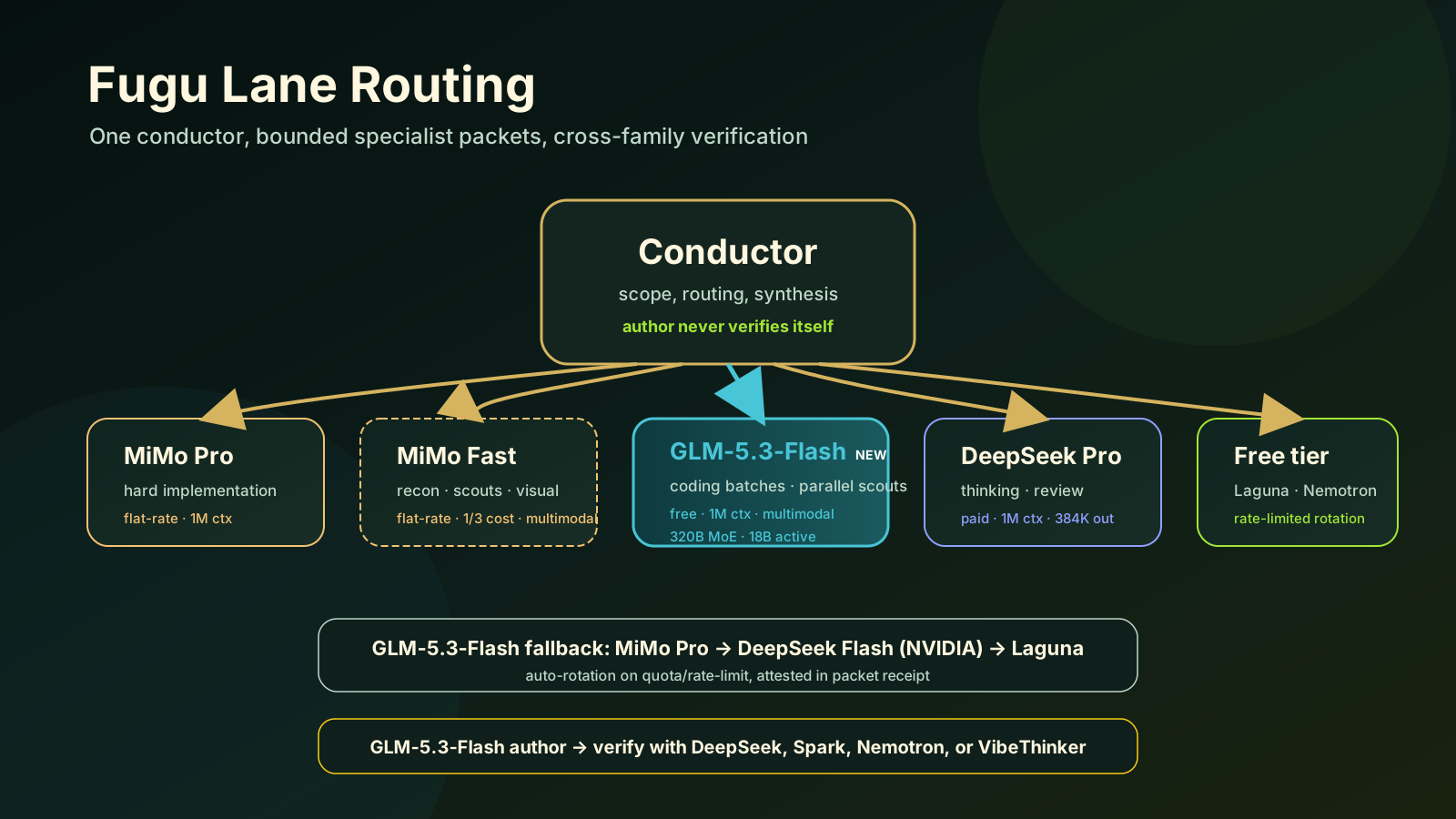
My daily driver is T3 Code, which sits on top of installed provider CLIs — Claude Code, Codex, Hermes, OpenCode. It gives me one surface to approach multiple harnesses. Underneath that, I run a Fugu orchestration layer: one conductor, bounded specialist packets, cross-family verification. The conductor routes work to lanes — worker-spark, worker-flash, worker-pro, worker-mimo, and now worker-glm53.
The economic constraint is real. I do not have unlimited API budget. So the fleet is designed around three tiers:
- Flat-rate subscription — MiMo Pro via Xiaomi's Token Plan. Predictable cost, coding-only, 1M context.
- Free-tier lanes — OpenRouter free models, NVIDIA NIM free tier, and whatever else is available at $0.
- Paid upgrades — DeepSeek Pro, OpenRouter paid models, used only when the free lanes cannot handle the work.
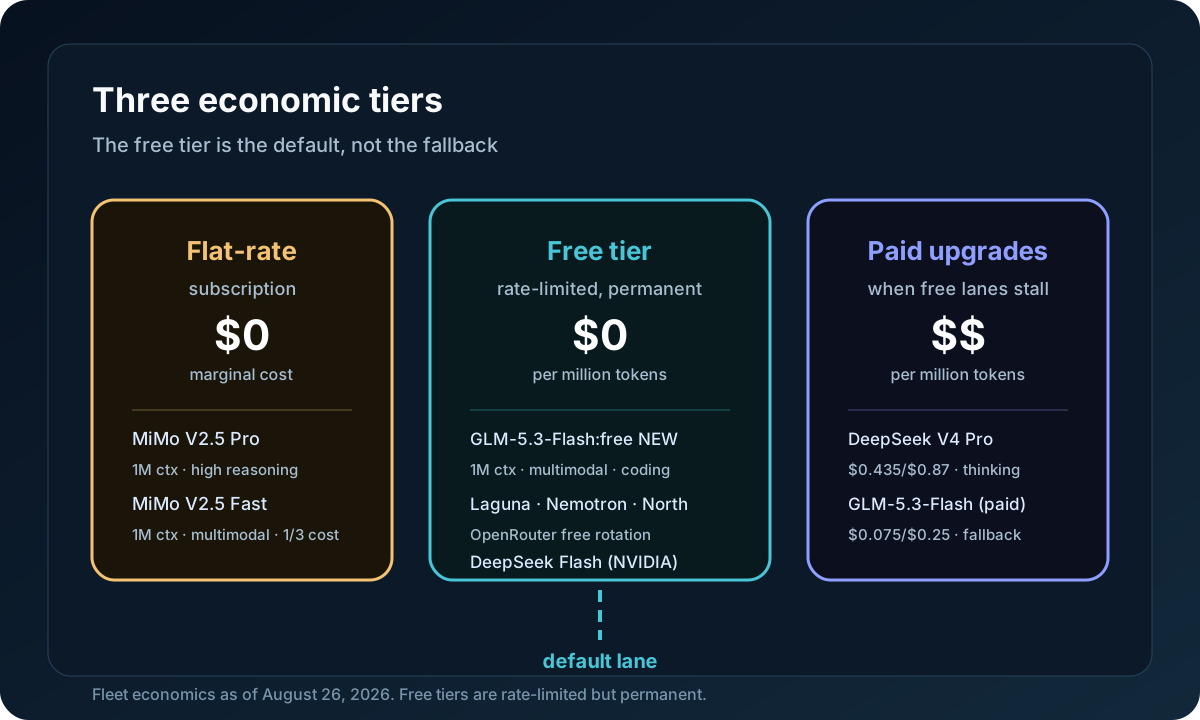
The free tier is not a compromise. It is the default.
MiMo Pro and the delegate pattern
MiMo Pro (mimo-v2.5-pro) is the backbone. It runs through T3 Code via the OpenCode provider, pointing at Xiaomi's Token Plan endpoint in Singapore. The API rejects literal max reasoning effort on the OpenAI path, so high is the ceiling. That is fine. The model is strong enough for daily coding, refactoring, and bounded review.
The interesting part is the delegate pattern. MiMo has a fast sibling — mimo-v2.5, the multimodal non-pro variant. It costs one-third of Pro's credit burn (100/200 credits per token versus 300/600). I use it for reconnaissance: reading screenshots, scanning repos, generating test stubs, parallel scouting. Pro handles the hard implementation. Fast handles the legwork.
This is not a novel pattern. But it works particularly well when both models share the same provider, the same context window, and the same tool-calling contract. The delegate does not need to re-learn the repository. It just runs cheaper.
The OpenRouter free tier
OpenRouter's free models are rate-limited and change over time. The September 2 snapshot included MiniMax M3, MiniMax M2.7, GLM-5.2, and Ling 3.0 Flash Fin among the exact $0 Chinese/Asian rows. My current free-tier roster is a snapshot, not a promise:
- Laguna S 2.1 (
poolside/laguna-s-2.1:free) — the free fixture, good for bulk throughput - Nemotron 3 Ultra (
nvidia/nemotron-3-ultra-550b-a55b:free) — the thinking model, good for review - North Mini Code (
cohere/north-mini-code:free) — lightweight coding helper - GLM-5.2 (
z-ai/glm-5.2:free) — 256K context, strong at tool use, rate-limited - MiniMax M3 (
minimax/minimax-m3:free) — 1M context, native multimodality, rate-limited - MiniMax M2.7 (
minimax/minimax-m2.7:free) — 196K context, rate-limited - Ling 3.0 Flash Fin (
inclusionai/ling-3.0-flash-fin:free) — 262K context, finance-focused, rate-limited
These are not toys. Laguna has gone 94/94 on bounded coding tasks in my Fugu setup. Nemotron produces genuinely useful architecture review. The rate limits are real — you cannot run a tight loop on a free model — but for a single bounded packet, they work.
The Fugu adapter handles rotation automatically. When a lane hits quota or rate-limit, it falls back to the next free tier hop. Every hop is attested in the packet receipt. No silent substitution.
The Ox Alpha mystery
For the past week, a model called ox-alpha has been the talk of the coding-agent community. It appeared on OpenCode around August 20, unannounced, with no provider attribution. The performance was immediately notable — strong coding, good tool use, long context, and apparently free. OpenCode's usage data showed $0.00 total spend across roughly 44 trillion tokens processed.
I started using it through OpenCode's /models selector. The experience was good. Not perfect — the model is verbose, and it sometimes over-explains — but for bounded coding tasks it was competitive with models that cost real money. I ran it on refactoring, test generation, multi-file edits, and architecture review. It held up.
The speculation was wild. Some people thought it was a new OpenAI model. Others guessed Google, Meta, or a Chinese lab. The ox-alpha name was deliberately opaque.
The reveal
Today, Z.ai confirmed it: ox-alpha is GLM-5.3-Flash.
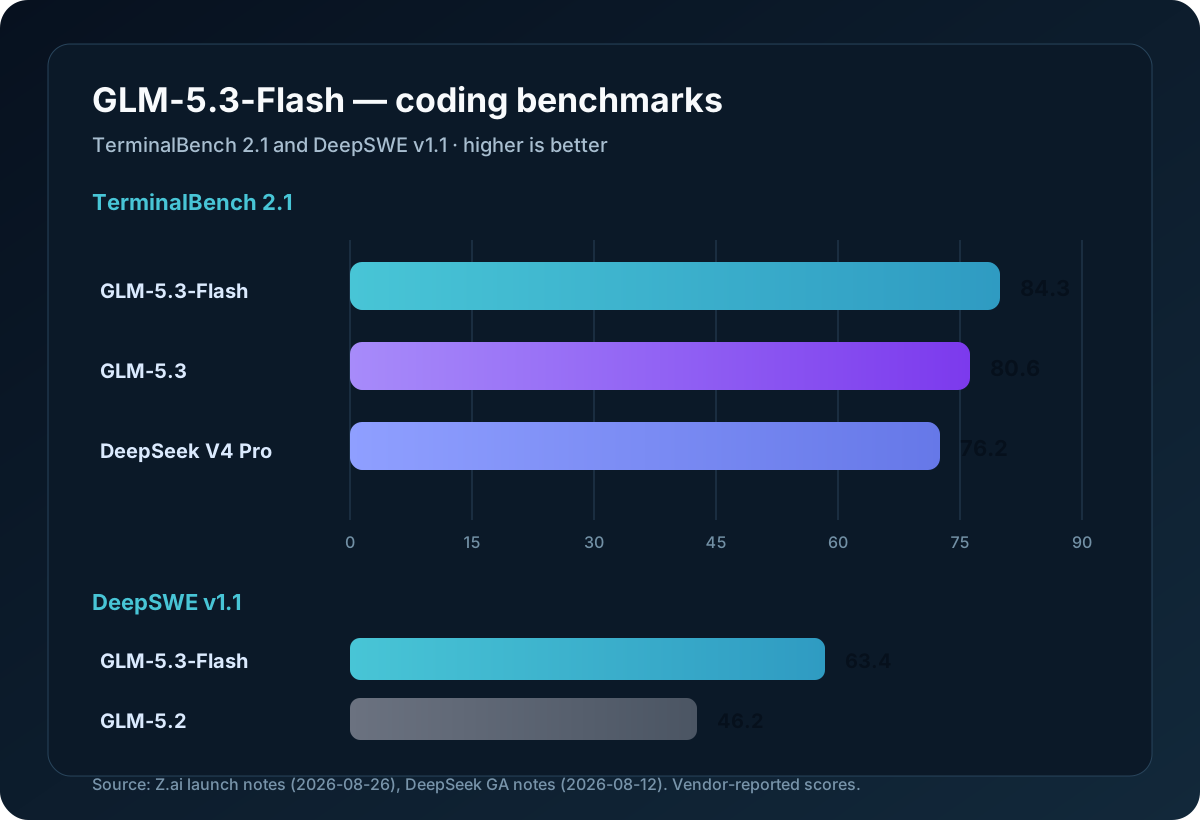
GLM-5.3-Flash is a 320B mixture-of-experts model with approximately 18B active parameters per token. It supports 1M tokens of context (OpenRouter exposes ~1.31M), multimodal input (text, images, video), and text output. The benchmarks are strong:
- 84.3 on TerminalBench 2.1
- 63.4 on DeepSWE 1.1 (versus 46.2 for GLM-5.2)
- #3 of 108 models on Artificial Analysis Intelligence Index (score 57)
It is MIT-licensed, open-weight, and runnable locally via vLLM, SGLang, TokenSpeed, or KTransformers. That is a lot of capability for a model that had a short-lived free preview before the current paid route.
What is actually free now
I refreshed the model inventory on September 2 rather than treating every Asian model as a free lane. The live OpenRouter API returned 425 model records and 18 exact $0 rows. In the Asian-origin group, MiniMax M3, MiniMax M2.7, GLM-5.2, and Ling 3.0 Flash Fin were listed at zero input and output price. GLM-5.3-Flash is available and has a 1.31M-token context window, but the current route is paid at $0.075 per million input tokens and $0.25 per million output tokens.
The same distinction matters for the other models I would actually want in a coding fleet. DeepSeek V4 Flash, Xiaomi MiMo V2.5, Qwen3.8 Flash, and Kimi K2.7 Code are present in the live catalog, but their current OpenRouter rows are paid. Open weights, a limited-time trial, an app entitlement, and a $0 aggregator row are different things. The chart is therefore a context-and-price snapshot, not a capability leaderboard.
The practical takeaway is narrower and more useful: keep GLM-5.3-Flash as the high-capability paid comparison lane; use MiniMax M3 and GLM-5.2 when the exact OpenRouter free listing is the priority; and treat DeepSeek, MiMo, Qwen, and Kimi as low-cost or entitlement-dependent Asian routes until a fresh authenticated probe proves otherwise. OpenRouter's programming collection currently puts GLM-5.3-Flash, MiMo V2.5, and DeepSeek V4 Flash near the top of its usage ranking, but usage share is not a benchmark score and does not make a model free.
The free route
Here is the part that matters for the fleet: GLM-5.3-Flash is available on OpenRouter, but the current route is paid rather than an exact $0 free row.
The current live model slug is z-ai/glm-5.3-flash. OpenRouter exposes roughly 1.31M context and lists the route at $0.075 per million input tokens and $0.25 per million output tokens. The older z-ai/glm-5.3-flash:free reference in the original field note is not supported by the September 2 exact-zero API snapshot, so it should not be treated as a working free endpoint. The stable free comparison in this audit is z-ai/glm-5.2:free; MiniMax M3 is another current exact-zero Asian-origin row.
The paid route is also cheap: $0.075 per million input tokens and $0.25 per million output tokens in the live API snapshot. OpenRouter separately shows a temporary introductory discount, so treat the API-row prices as the durable comparison rather than assuming the promotion is permanent.
Wiring it in
I spent this afternoon wiring GLM-5.3-Flash into the fleet. The changes:
Hermes profiles. The original code-glm53-free and lead-glm53-free profiles were pointing at a dead ZenMux endpoint that returned 403 on completions. The current audit does not treat z-ai/glm-5.3-flash:free as a working free route: the live exact-zero snapshot lists z-ai/glm-5.2:free instead, while GLM-5.3-Flash is a paid OpenRouter route.
Fugu lanes. worker-glm53 and lead-glm53 were disabled since August 19 because no reliable free endpoint existed. The current fallback chains route through worker-mimo → worker-nv-flash → worker-laguna; GLM-5.3-Flash belongs in a paid or locally hosted lane until a fresh free endpoint probe succeeds.
Fleet policy. The glm53 aliases were unblocked. GLM-5.2 aliases remain blocked — NVIDIA retired that endpoint on August 21.
OpenCode config. The old z-ai/glm-5.3-flash:free picker entry should be considered historical. The current live catalog entry is z-ai/glm-5.3-flash without the :free suffix.
FUGU-CODEX. Updated the roster, the available lanes list, and the verification matrix. GLM-5.3-Flash authors get cross-family verification from DeepSeek, Spark, Nemotron, or VibeThinker — never another GLM lane.
Where it fits
GLM-5.3-Flash slots into the fleet as a cheap paid coding-batch specialist. Same broad role as the old GLM-5.2 lane, but with a current catalog route. The use cases:
- Mid-complexity implementation tasks
- Parallel scouts alongside MiMo Fast
- Bounded coding packets where DeepSeek Flash would be the default
- Multimodal tasks — the model can inspect screenshots while coding, which neither DeepSeek nor MiMo Pro can do natively
It is not a replacement for MiMo Pro on hard architecture work, and it is not a replacement for DeepSeek Pro on thinking-heavy tasks. It is a low-cost paid lane that is strong enough to be a legitimate primary worker for everyday coding when free capacity is throttled.
The economics
Let me be honest about the numbers. My current daily cost structure:
- MiMo Pro — flat-rate subscription, effectively $0 marginal cost per token within the plan
- OpenRouter free lanes — $0 (rate-limited)
- NVIDIA NIM free lanes — $0 (quota-limited)
- DeepSeek Pro — $0.435/$0.87 per million tokens, used sparingly
- OpenRouter paid — varies, used only when free lanes are exhausted
GLM-5.3-Flash is not a free lane in this snapshot, but its $0.075/$0.25 route is cheap enough to use as a paid comparison or fallback when the free fleet is throttled.
The broader trend is more nuanced: capable coding models are becoming cheap, while exact $0 access remains provider- and snapshot-dependent. MiniMax M3 and GLM-5.2 are free rows here; MiMo and DeepSeek are low-cost or plan-dependent; GLM-5.3-Flash is a cheap paid route. That distinction changes what is possible with multi-model fleets without pretending that catalog price equals reliable access.
What I am watching next
The ox-alpha free preview was explicitly temporary — roughly one week from August 20. It disappeared from the exact-zero GLM-5.3-Flash route in this September 2 snapshot. The OpenRouter free tier is a moving roster, not a permanent entitlement.
I want to test GLM-5.3-Flash on longer-running agent tasks. The model is specifically optimized for long-horizon work, and the 1M context window is real. If it can hold engineering context through a full development workflow — from requirements to multi-file implementation to test generation — it earns a permanent slot in the rotation.
I also want to test the multimodal input on real tasks. Can it read a screenshot of a broken UI and produce a correct patch? Can it inspect a design mockup and generate matching CSS? Those are tasks where MiMo Fast (also multimodal) currently works, and a second multimodal low-cost lane could be valuable.
The open weights mean I can eventually run it locally. That is useful for privacy-sensitive work or offline scenarios, especially now that the hosted GLM-5.3-Flash route is paid. The MIT license makes local hosting a practical option, subject to hardware and serving costs.
The meta point
This fleet is not about finding the one best model. It is about building a system where the right model gets routed to the right task, automatically, at the lowest possible cost. MiMo Pro for daily coding. MiMo Fast for reconnaissance. DeepSeek Pro for hard reasoning. GLM-5.3-Flash for cheap paid coding batches. MiniMax M3, MiniMax M2.7, GLM-5.2, Ling 3.0 Flash Fin, Laguna, and Nemotron for free-tier bulk work.
The conductor orchestrates. The lanes execute. The verification matrix catches errors. The cost stays near zero.
Today that system got a more accurate price map: four Chinese/Asian exact-zero rows, plus GLM-5.3-Flash as a cheap paid comparison lane.