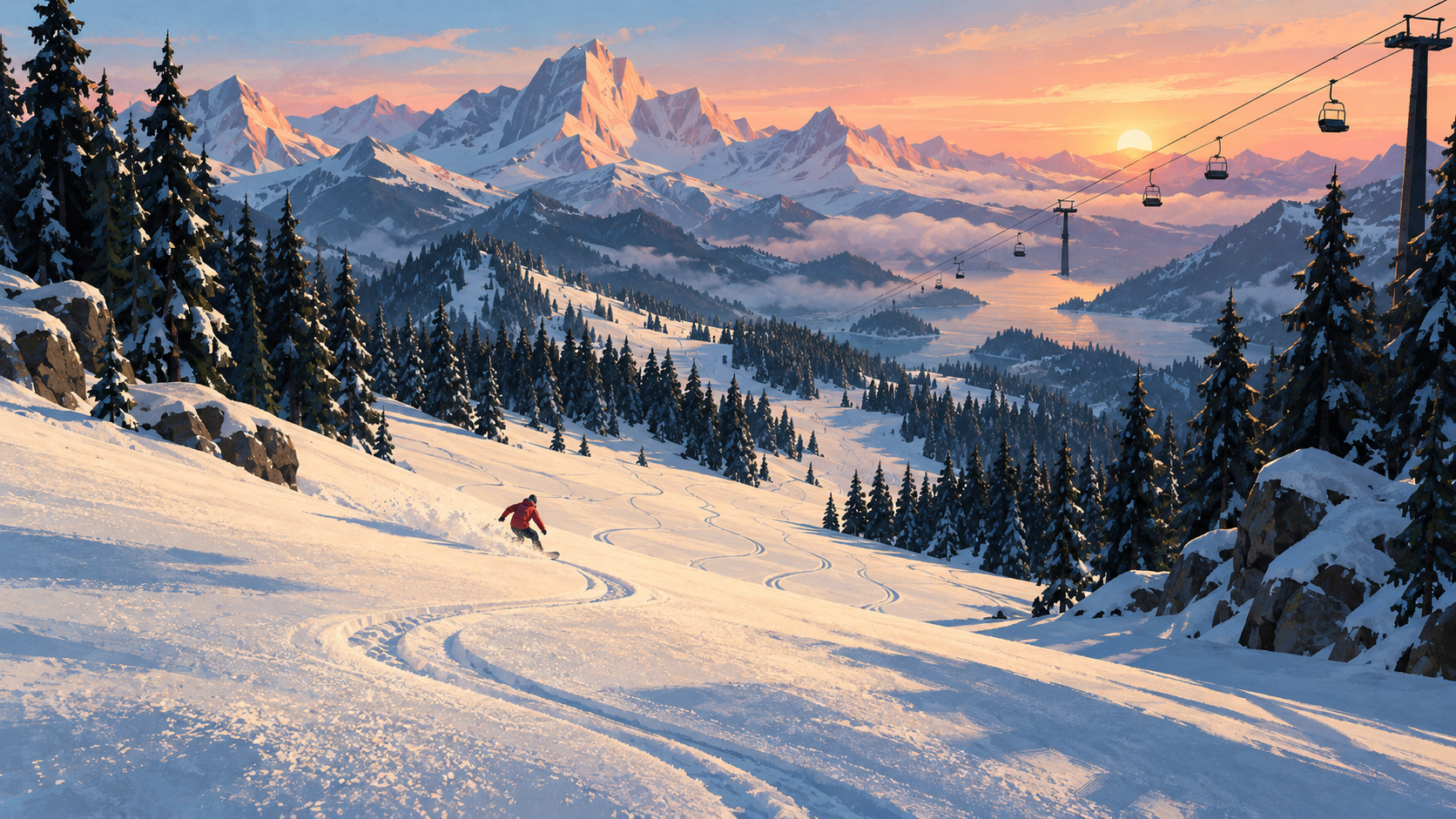
Look uphill after a long turn. The rider has moved on. Powder settles among the trees, but a pale groove still curls across the slope. It records a small decision: someone leaned here, hesitated there, let the board run a little longer.
That is a surprisingly rich kind of presence. A mountain can feel inhabited before another person appears. A track gives open space a past.
The surface remembers
The isolated PixiJS 8 snow demo described in my design notes offers a starting point for Champions of Snowboarding: steering, braking, ridges, powder and persistent visual tracks. Its displacement is visual; the notes do not establish snow forces that change how the board rides.
Even within that boundary, a turn can leave something worth looking back at. The map's dense forest at the edges, open path, diagonal lift and flat starting shelf give the eye somewhere to travel. A track could give it a reason to return.
John Edwards's GDC talk on rendering the sand in Journey describes a surface continually refined during the game's development. The useful invitation here is to take the ground seriously as an expressive part of the world.
For a future snow study, a fresh carve might hold a crisp edge. A braking patch might spread into a rough fan. An older line might soften until it becomes something you notice only when the light catches it.
What deserves to last?
The technical vocabulary is close at hand. PixiJS's rendering documentation describes drawing into texture-backed targets without clearing their contents. That offers a way to accumulate marks, although retaining them across visits and simulating snow require more.
The art question comes first. Should a first imperfect turn survive until the next run? Would finding it again feel satisfying, or would too many marks make the slope harder to read?
Those choices have different answers at different scales. One memorable line can make a familiar hill feel personal. A mountain covered edge to edge in permanent scuffs could lose the quiet that made the first trace matter.
An empty slope does not need to stay untouched to feel quiet. Sometimes it feels most alive when a small trace remains.