
GPT-6.1 Sol makes an interesting value proposition: benchmark performance close to Astra at a substantially lower measured task cost. The harder question is what that buys someone working in Codex. A similar aggregate score does not guarantee the same results on your tasks, higher token throughput does not guarantee a quicker finish, and lower API prices do not directly determine your Plus or Pro allowance.
A Reddit comparison graphic brings those questions together. Here is what the linked benchmarks and pricing documentation support, where users’ experiences differ, and what remains uncertain. The numbers below are a snapshot checked on October 2, 2026.
The Reddit graphic asks the right questions
The r/ChatGPTPro post by u/un-pulpo-BOOM asks whether a reported 68.8% reduction in Intelligence Index cost versus GPT-5.6 implies roughly 3.2 times more Codex usage, and whether Sol Max matching Astra ExtraHigh on that index means similar real-world capability. The chart plots Artificial Analysis Intelligence Index against benchmark task cost across effort levels. Its labels also reveal the caveat: it shows Astra through XHigh, not Max, so it does not compare Sol Max with Astra Max.

The comments describe sharply different experiences: one user reports substantial allowance use during Astra Ultra; another reports long Sol Max sessions with Luna helpers and much allowance remaining, while finding it slow. These are unverified anecdotes with different tasks and settings, not a controlled comparison or a community consensus.
Near-Astra performance is a useful result with a specific scope
Artificial Analysis’s current Max-versus-Max comparison shows Sol at 52 and Astra at 53 on Intelligence Index v4.3.2. Its weighted task costs are $0.72 and $3.26 respectively. In that evaluation, Sol’s cost is about 22% of Astra’s: approximately 78% lower.
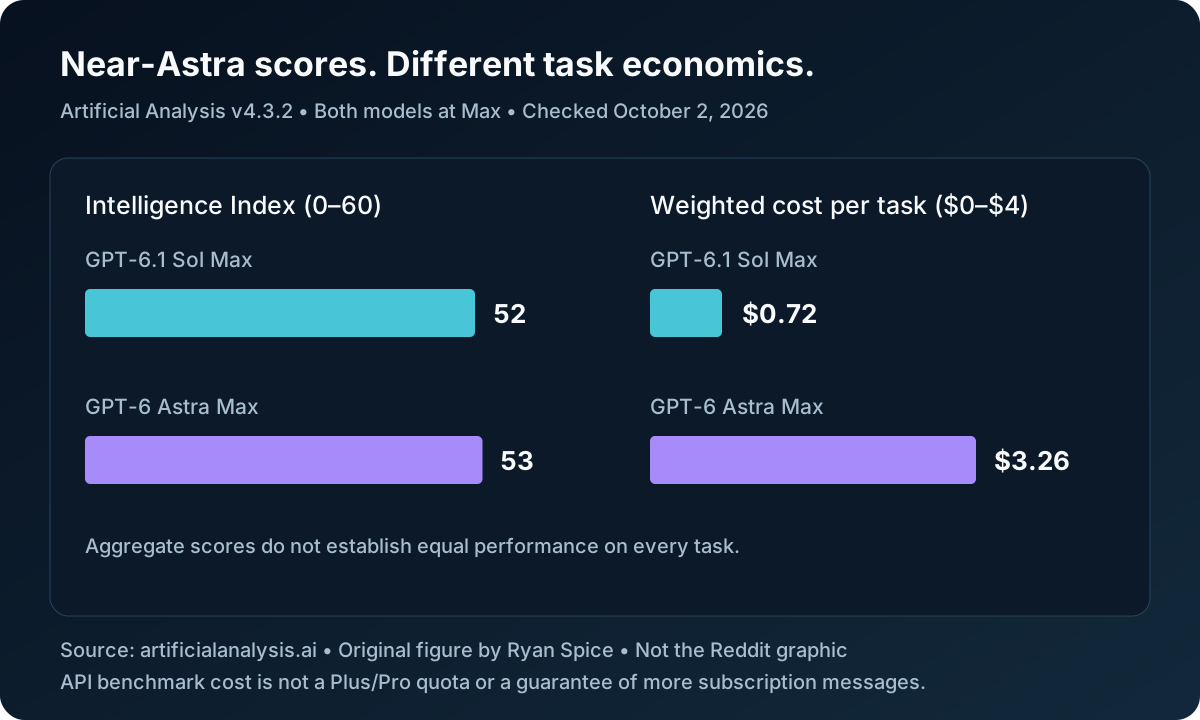
View the comparison graphic at full size.
The aggregate hides differences. Terminal-Bench 4.0 is 56% versus 59%; AutomationBench-AA is 65% versus 68%. Sol leads on the reported AA-LCR long-context result, 83% versus 81%. These results support testing Sol on demanding work; they do not establish interchangeable behavior across every task.
Speed also needs a denominator. The comparison lists higher output throughput for Sol, but longer average time per benchmark task: roughly 607 seconds versus Astra’s 503. Tokens per second, total task duration and useful work completed are different measurements. This snapshot does not measure performance in my Codex sessions or establish that the launch slowdown has ended for every user.
Lower rates do not promise 3.2 times more subscription usage
The arithmetic behind the Reddit question is reasonable: a 68.8% cost reduction leaves 31.2%, whose reciprocal is about 3.21. The missing step is proving that the benchmark’s cost maps directly to the subscription meter. I have not independently reproduced that specific GPT-5.6 comparison.
OpenAI’s Sol API page lists Standard rates of $2 input and $10 output per million tokens, with $0.10 cached input. Astra’s API rates are $10 input and $50 output. These are API prices, not Plus or Pro message entitlements.
The subscription pricing documentation explicitly warns that credit rates do not determine how quickly included limits are consumed. Context, reasoning, tools, retrieval and caching affect usage. It estimates 15–160 local Sol messages per five hours for Plus, compared with 5–45 for Astra; those are workload-dependent estimates. Pro currently has no five-hour limit, but weekly limits may apply.
Fast mode draws included usage at 2.5 times Standard; Astra Ultrafast at eight times Standard. Those are billing multipliers, not speed guarantees. A task that needs fewer retries may improve practical value, while a larger context or more expensive mode can erase the saving. The account’s current usage dashboard is the place to verify remaining capacity and reset times.
A brief note on the reset: Tibo promised a paid-account usage reset for October 2 at “10am PST,” or roughly 1–2 p.m. Toronto depending on the time-zone reading. My account received its reset at approximately 5 p.m. Toronto time (EDT), after that window. This confirms my account’s receipt, not universal delivery. The episode illustrates why predictable access and clear rollout updates matter alongside benchmark value.
Judge value by useful work completed
Sol’s near-Astra aggregate result and lower measured task cost make it a promising option to evaluate on demanding work. The comparison also shows why one headline number is insufficient: individual benchmarks differ, and higher output throughput can coexist with a longer task duration.
For a practical comparison, use representative tasks at stated effort and speed settings. Track accepted results, elapsed time, retries and allowance consumed. Those measurements tell you whether a cheaper model helps you finish more work. The available evidence supports a strong performance-per-dollar case for Sol; it does not establish an automatic 3.2-times increase in subscription capacity or a universal replacement for Astra.
What I verified
I checked the linked Reddit text and comments, Artificial Analysis’s comparison, and OpenAI’s model and pricing documentation on October 2. The Reddit graphic’s pixels could not be inspected; the accompanying numerical figure is my own rendering of the separately checked Max-versus-Max data. The reset aside records my account’s receipt at approximately 5 p.m. Toronto time, with the announcement timestamp cross-checked against the linked mirror. I did not run a model benchmark, inspect readers’ accounts, or verify a universal reset. The benchmark and pricing figures are a dated snapshot.