On September 21, 2026, Xiaomi published the MiMo-V2.6 series and open-sourced the weights. The headline pair is MiMo-V2.6-Pro and MiMo-V2.6-Flash, both positioned as native omnimodal models — text, image, video, audio — with a 1-million-token context window and agent-shaped capabilities including computer use and 3D spatial reasoning.
Alongside them, Xiaomi released MiMo-V2.6-Distill-Qwen-9B, the supporting reinforcement-learning research resources, and a written-up set of verified training practices. The Pro-RL and Flash-RL model cards are on Hugging Face under the MIT license, in the MiMo-V2.6 collection.
The API also went live on the Xiaomi MiMo Open Platform with pricing unchanged from V2.5, plus an OpenRouter listing and a desktop client that exited early access.
What actually shipped
| Piece | What it is |
|---|---|
| MiMo-V2.6-Pro | Flagship open-weight model, 1M context, multimodal, MIT weights. |
| MiMo-V2.6-Flash | Smaller/faster sibling, same release lane, MIT weights, cheap API. |
| MiMo-V2.6-Pro-UltraSpeed | API serving variant, reported up to ~20× faster output than Pro at the same quality; weights not separately confirmed. |
| MiMo-V2.6-Distill-Qwen-9B | Distilled 9B checkpoint plus RL research resources. |
| MiMo Desktop | First official desktop client release with Pro and Flash built in, plus a membership plan. |
| MiMo Code | Xiaomi's open-source terminal coding agent, built on the OpenCode foundation. |
That last row is worth pausing on. Xiaomi's own terminal agent is an OpenCode derivative, which is part of why a free OpenCode Zen lane for the new Flash model reads less like a random promo and more like two ends of the same distribution strategy meeting.
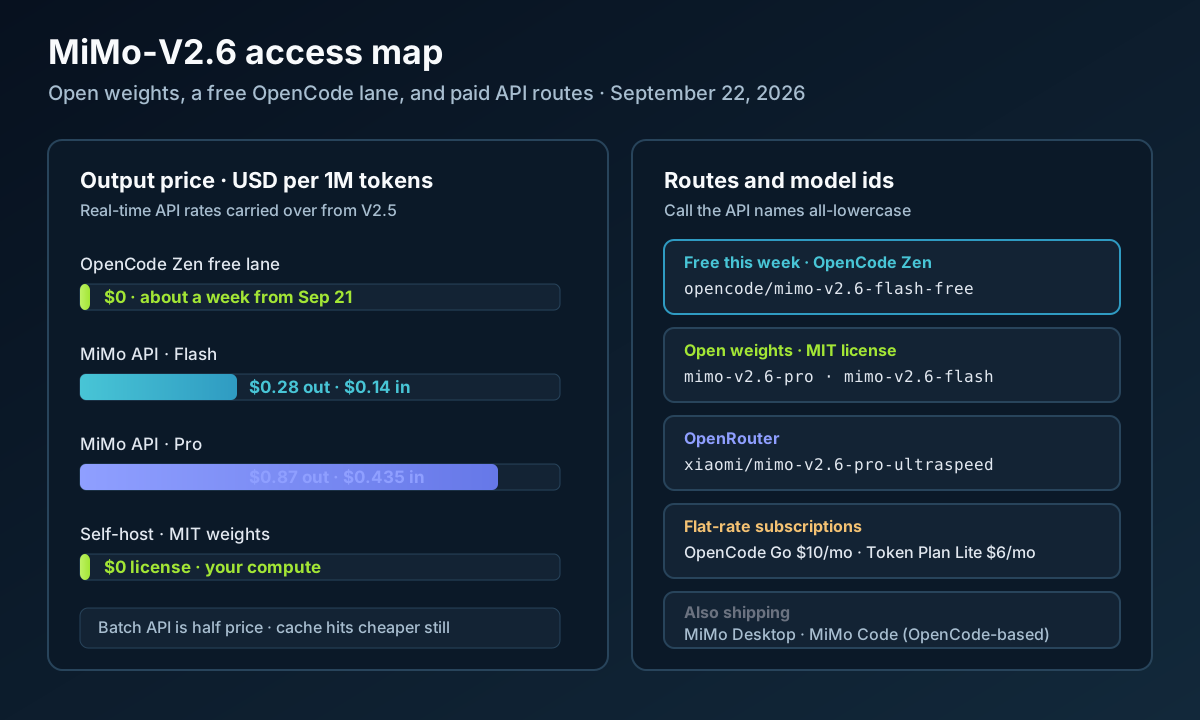
Call the models all-lowercase on the API: mimo-v2.6-pro, mimo-v2.6-flash, mimo-v2.6-pro-ultraspeed. On OpenRouter they appear as xiaomi/mimo-v2.6-pro, xiaomi/mimo-v2.6-flash, and xiaomi/mimo-v2.6-pro-ultraspeed.
The RL story underneath
Xiaomi frames V2.6 as a step on the RSI — recursive self-improvement — path: scale RL compute on verifiable complex tasks and let exploration and feedback keep pushing the boundary.
Per TechNode's read of the release, the two models completed 30 reinforcement-learning steps in under six days using roughly 750,000 trajectories, at reported costs of about $2.62M for Pro and $850K for Flash.
Whether or not you buy the RSI framing, the operational claim is concrete: this is a serious RL spend behind weights you can download under MIT. That combination — capital-intensive training, permissive licensing — is still the part of the Chinese open-weight wave that most unsettles the assumption that frontier-shaped models have to stay behind an API meter.
Pricing: unchanged, and now with a free lane
Overseas real-time API pricing carried over from V2.5. Batch API is half price.
| Route | Input (per 1M) | Output (per 1M) | Notes |
|---|---|---|---|
| MiMo API · Flash | $0.14 | $0.28 | Cache hits cheaper; batch half price. |
| MiMo API · Pro | $0.435 | $0.87 | Cache hits at $0.0036/M per published rate. |
OpenRouter · xiaomi/mimo-v2.6-* |
metered | metered | One key across providers. |
OpenCode Zen · opencode/mimo-v2.6-flash-free |
$0 | $0 | Limited-time free lane; 200K context listed. |
| OpenCode Go | — | — | $10/month, includes Pro and Flash among 30+ models. |
| Xiaomi Token Plan Lite | — | — | $6/month, 4.1B credits, works in OpenCode and Claude Code. |
| Hugging Face weights | — | — | MIT; your compute, your deployment. |
OpenCode has it free
This is a time-limited offer, so verify it before relying on it. The launch announcement described the free period as about a week from September 21; OpenCode's current Zen listing is the source of truth for whether it is still active.
On September 21, OpenCode announced that MiMo-V2.6-Flash would be free in OpenCode Zen for about a week. The model id is:
opencode/mimo-v2.6-flash-freeIt serves from https://opencode.ai/zen/v1 over an OpenAI-compatible completions API, lists 200,000 tokens of context and 32,000 max output tokens, and prices every meter — input, output, cache read, cache write — at $0.
In practice: open a project, run opencode, type /models, and pick MiMo V2.6 Flash Free (Zen) if the label appears in your picker. Check for that label before a long session — the public Zen docs were still showing the older MiMo-V2.5 Free listing for a bit after the announcement, and at least one user replied to the launch post with a usage screen showing charges. Verify you are actually on the free variant.
Three caveats, none of them exotic:
- It is Flash, not Pro. Pro is real, but it lives behind OpenCode Go ($10/month), your own Xiaomi key, Token Plan, or OpenRouter.
- It is time-limited. OpenCode announced roughly a week from September 21, but the exact end time is not stated here. Check the current Zen listing and your
/modelspicker before using it. Ifopencode/mimo-v2.6-flash-freeis gone or no longer marked free, do not assume another MiMo route is free: use a paid API route only after checking its current price, or run the MIT weights on infrastructure you control. - The data caveat is explicit. OpenCode's Zen documentation says data collected from its MiMo free models may be used to improve the model. Do not send confidential client repositories or customer data through the free lane. The weights are MIT and the paid API is metered normally — the caution applies specifically to the free trial endpoint.
A separate check worth running: earlier MiMo Pro endpoints on OpenRouter had trouble accepting native tools calls, which made them awkward in agent harnesses. The V2.6 generation appears to have fixed that — published testing of xiaomi/mimo-v2.6-pro through OpenCode's desktop app passed multi-step tool tasks that V2.5 struggled with. If your rotation depends on native tool calls, re-test instead of assuming last month's limitation still holds.
(Disclosure: this article was written on opencode/mimo-v2.6-flash-free, the free lane it describes.)
Offshoot: the Codex reset economy
While the open-weight side of the agent economy was doing a launch, the subscription side was doing what it always does around a major rollout — resetting quotas.
Tibo — Thibault Sottiaux, who works on Codex and ChatGPT at OpenAI — has kept up the familiar pattern through the GPT-6 Astra rollout: banked resets on September 3 and 4, a global reset on September 7, and then a quality-fix post with another reset landing by midnight on September 11. OpenAI's help center now documents banked resets as a formal mechanism: a one-time Codex usage refresh you apply yourself, separate from the automatic global kind.
The reason to embed this next to a MiMo launch post is that both stories are the same story from two directions. Usage economics for coding agents are softening on both sides at once. Subscription vendors are papering over rollout friction with goodwill resets and banked quota. Open-weight vendors are giving away a week of a new Flash model to pull people into an ecosystem where the real product is the desktop client, the membership, the token plan, or the API. Free is the acquisition motion in both cases; the question is always what the free lane is training you to reach for next.
The other side: GPT-6 Sol, Luna, and the subscription reprice
The Astra rollout brought more than resets. Tibo's posts through September reference two model names that matter for anyone budgeting agent workloads:
| Model | Context | What changed |
|---|---|---|
| GPT-6 Astra | Flagship rollout to Plus/Pro/Business, then Plus | Banked resets Sep 3–4, global reset Sep 7, quality-fix reset Sep 11. Positioned as the new default for Codex. |
| GPT-5.6 Sol | "Explore the boundaries" tier for 8M-user milestone | Weekend reset Sep 13, 5h rate limit lifted, marketed for ambitious long-horizon tasks. |
| GPT-5.6 Luna | High-throughput variant | "100,000 Luna threads this weekend" reset Sep 12, 5h limit removed, framed for volume experimentation. |
The practical signal: OpenAI is using quota resets as a price lever. Instead of cutting per-token rates, they expand the effective allowance — banked resets, lifted 5-hour caps, weekend unlimited windows — which lowers the effective cost per useful agent-hour. For teams on Plus/Pro/Business, the marginal cost of a Codex session dropped sharply in September without a published price change.
Meanwhile, the open-weight side is doing the inverse: MiMo-V2.6-Flash at $0 for a week, then $0.28/M output on API, or $0 forever if you self-host the MIT weights. The subscription side softens quotas; the open-weight side hardens a price floor at zero.
If you run a mixed fleet — some tasks on Codex, some on OpenCode with MiMo or DeepSeek — the September shift means the subscription portion just got cheaper in practice while the open-weight portion got a new free entry point. The rotation math changes: you can afford more Codex escalation because the quota resets absorb the spikes, and you have a credible free parallel worker (MiMo Flash on Zen) for the bread-and-butter tasks that don't need GPT-6.
Where this sits in the rotation
This does not displace the September rotation built around DeepSeek V4.1 Flash as the daily driver and GLM 5.3 for escalation. What V2.6 changes is the free and near-free tier:
| Slot | Before | After V2.6 |
|---|---|---|
| Free parallel worker | Unbiased Pareto, Big Pickle | Add opencode/mimo-v2.6-flash-free while the week lasts. |
| Cheap strong reasoning | GLM 5.3 Flash | Flash API at $0.28/M out is now a serious challenger. |
| Free second opinion | Big Pickle (OpenCode Zen) | Same slot, one more strong occupant. |
| Self-hosted option | — | MIT Pro-RL / Flash-RL weights are the new floor. |
The earlier free-model fleet note already had MiMo Pro as a delegate tier. V2.6 refreshes both ends of that: the delegate gets a real generation bump, and the free lane moves from a static free tier to a launch-window trial.
What to check now
- Confirm MiMo V2.6 Flash Free actually appears with a Free label in your OpenCode
/modelspicker before starting a long session. - Keep confidential repos off the free Zen lane while the improvement-data caveat applies.
- If you route by model id, switch to the all-lowercase V2.6 names and re-run a live availability check.
- Agents that need native
tools: re-testmimo-v2.6-prorather than inheriting the V2.5 limitation. - Check whether the free window is still active. If the model is gone or no longer marked free, use a currently priced API route or self-host the MIT weights; do not assume the offer rolled into OpenCode Go.
- Codex users: check Settings → Usage for any banked reset before assuming the global one applied to your plan.
Sources
- Xiaomi MiMo — MiMo-V2.6 release notes
- Hugging Face — MiMo-V2.6 collection
- TechNode — Xiaomi open-sources MiMo-V2.6 after scaling reinforcement learning
- fonearena — Xiaomi MiMo-V2.6-Pro and Flash features
- kie.ai — What is Xiaomi MiMo V2.6
- kingy.ai — Is MiMo-V2.6-Pro free? Pricing, setup, and OpenCode test
- OpenCode Zen — MiMo-V2.6-Flash Free model listing
- Xiaomi MiMo — OpenCode configuration guide
- Tibo on X — Astra quality fixes and reset landing by midnight
- OpenAI Help — How banked Codex resets work